
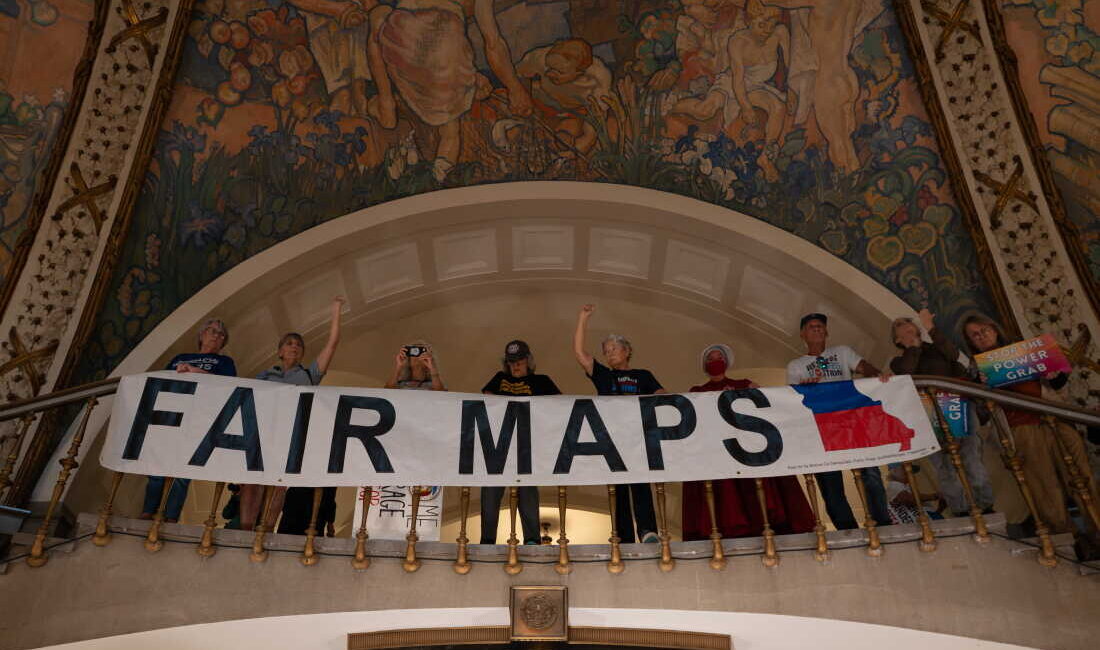
Missouri has become the center of an extraordinary legal and political battle over congressional redistricting, as courts clash over whether the state can use a Republican-drawn map backed by President Donald Trump in the November midterm elections.
The dispute is part of a much broader national struggle over control of the U.S. House. Republicans currently hold six of Missouri’s eight congressional seats, but the new map was designed to improve their chances of capturing a seventh.
At Trump’s urging, Missouri Gov. Mike Kehoe called lawmakers into a special session last year to redraw the state’s congressional boundaries before the midterms. The most significant changes targeted the Kansas City-based 5th Congressional District, represented by longtime Democrat Emanuel Cleaver.
The revised map divided portions of Kansas City among neighboring Republican districts while extending Cleaver’s remaining district into more conservative rural areas. According to an Associated Press analysis, approximately 59% of voters in the redesigned district would have been new to it.
But the Republican strategy encountered a powerful challenge from Missouri voters.
Opponents of the redistricting collected hundreds of thousands of petition signatures seeking a statewide referendum on the new congressional boundaries. The Missouri Supreme Court ultimately ruled that the petition suspended the new districts and that the map never legally took effect.
That decision created an extraordinary situation because Missouri had already used the Republican-backed districts during its August congressional primaries.
The state’s highest court ordered election officials to return to the congressional boundaries adopted in 2022 following the 2020 census for November’s general election.
Missouri Republicans appealed.
The U.S. Supreme Court initially declined to intervene, leaving the state Supreme Court’s ruling intact. But almost immediately afterward, U.S. District Judge Stephen Clark issued a conflicting federal order temporarily preventing Missouri from returning to the old districts.
Clark argued that changing congressional boundaries between the primary and general elections could create serious problems for candidates and voters. Candidates had already won nominations under one set of districts, meaning switching maps could leave some voters choosing among candidates they did not encounter during the primary.
The competing decisions produced significant confusion about which congressional districts would actually govern the November election.
The dispute quickly returned to the U.S. Supreme Court.
The justices ultimately declined again to restore the Trump-backed map, clearing the way for Missouri to use its 2022 congressional boundaries in November. Missouri Secretary of State Denny Hoskins subsequently instructed local election authorities to prepare ballots using the older districts.
The consequences could be substantial.
More than one million potential Missouri voters could find themselves voting in congressional districts different from those used during the August primary. The situation is extremely unusual and demonstrates the practical difficulties created when redistricting battles continue deep into an election year.
But Missouri’s fight is about considerably more than one congressional seat.
Trump encouraged Republican-controlled states to redraw congressional boundaries in the middle of the decade to strengthen the party’s position ahead of the midterms. Texas moved first, followed by Missouri and several other Republican-led states.
Democratic states responded with their own redistricting efforts.
The result has been an unprecedented national struggle in which both parties are attempting to use congressional maps to influence control of a narrowly divided House.
Republicans hoped new maps enacted across several states could produce as many as 16 additional favorable seats, while Democrats pursued countermeasures of their own, including new districts in California and Utah.
Missouri illustrates both the potential power and the risks of that strategy.
Republicans attempted to transform a competitive Democratic-held Kansas City district into territory considerably more favorable to their party. But citizen petitions, state constitutional protections and multiple layers of court intervention disrupted that plan.
The controversy also raises a fundamental democratic question: Should political parties be able to redraw congressional districts between censuses primarily because they see an opportunity to gain seats?
Supporters argue state legislatures possess broad constitutional authority over congressional maps and say maintaining the districts used during the primary avoids electoral chaos.
Opponents describe the effort as partisan gerrymandering designed to predetermine electoral outcomes and weaken voters’ ability to choose their representatives.
For now, Missouri appears headed toward November using its previous congressional map. But the larger redistricting war is far from over.
With control of Congress potentially determined by only a handful of seats, the battle demonstrates how congressional boundaries themselves have become one of the most powerful—and fiercely contested—weapons in American politics.