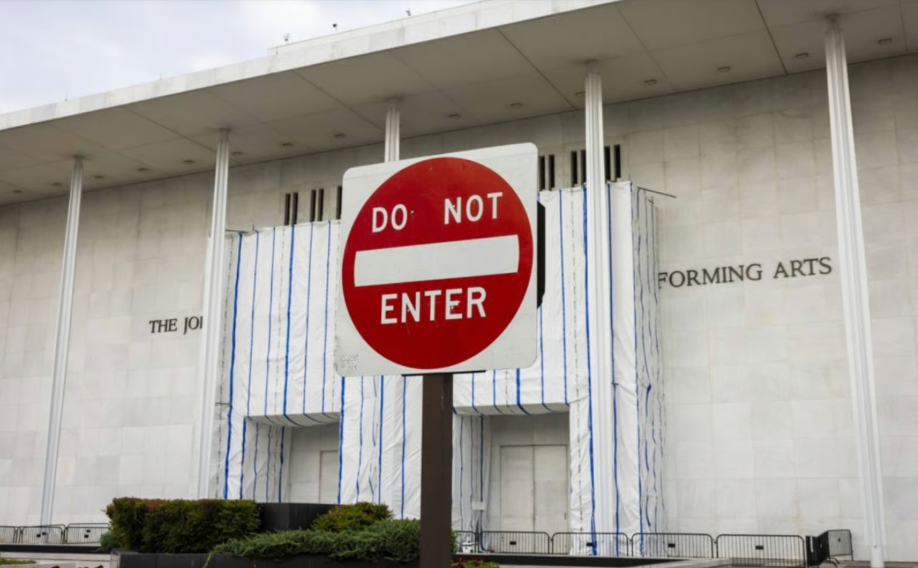
A federal judge has again blocked an effort to place President Donald Trump’s name on the John F. Kennedy Center for the Performing Arts, ruling that the institution’s board cannot alter the presidential memorial without authorization from Congress.
U.S. District Judge Christopher Cooper ruled on September 15 that the Kennedy Center could not add an inscription crediting Trump with restoring and renovating the building or rename its grounds the “President Donald J. Trump Plaza.”
The ruling represents the latest development in a prolonged legal and political battle over one of Washington’s most prominent cultural institutions.
The Kennedy Center was established by Congress as a national memorial to President John F. Kennedy following his assassination. Federal law specifically governs the center’s identity, and Cooper concluded that the board does not have unilateral authority to create additional presidential memorials on its exterior or grounds.
The dispute began after Trump took control of the Kennedy Center’s leadership and became chairman of its board. The board initially moved to add his name to the building, but Cooper ruled in May that the action violated federal law and ordered Trump’s name removed.
The center complied in June.
In August, however, the board approved a new approach. Instead of formally renaming the institution, trustees proposed placing an inscription on the facade stating that the building had been “restored and renovated” by Trump.
The board also approved renaming the surrounding grounds in his honor. Another proposed inscription would recognize the Trump Kennedy Center Fund if fundraising reached $100 million.
The administration argued that these measures did not constitute a formal renaming. Supporters on the board also said Trump deserved recognition for helping raise money and advance a major renovation of the aging building.
Cooper rejected that distinction for the proposed renovation inscription and plaza name.
He concluded that the board was effectively attempting to circumvent both federal law and his earlier court order. Congress, he ruled, deliberately established the building as a memorial to Kennedy and reserved authority over changes that would memorialize other individuals.
The decision does not necessarily resolve every proposed reference to Trump. Cooper declined to immediately prohibit the potential inscription recognizing the Trump Kennedy Center Fund because it was not clear that the inscription was about to be installed.
The Justice Department has appealed the court’s decisions.
The naming battle is unfolding alongside a much larger crisis at the Kennedy Center.
Hours after Cooper’s latest ruling, the Trump-aligned board voted to immediately close the main building for renovations, accelerating a previously planned shutdown that could last approximately two years.
Center officials argue that the building requires urgent repairs. A section of ceiling plaster recently fell about 60 feet inside the Grand Foyer, and subsequent inspections reportedly identified additional areas affected by water-related deterioration.
Congress has already allocated $257 million for renovations.
Trump, however, said renovations would not begin until an appeals court resolves the dispute over recognizing his name on the building.
The center is also confronting serious financial problems. Internal financial projections previously reported indicated significant revenue shortfalls, while ticket sales and fundraising have faced pressure amid controversy surrounding changes to the institution.
Critics of Trump’s leadership argue that the naming dispute has alienated performers, donors and longtime supporters. The center’s leadership has instead blamed earlier management for its financial difficulties and maintains that Trump can play an important role in raising money for its restoration.
Democratic Rep. Joyce Beatty of Ohio, an ex officio Kennedy Center trustee, has led the legal challenge against adding Trump’s name. She argues that the board’s actions violate federal law and undermine the institution’s status as a memorial to Kennedy.
The controversy has therefore evolved far beyond a dispute over signage.
It now involves questions about presidential power, congressional authority, cultural institutions, public memorials and the independence of organizations that occupy a unique position between government and the arts.
The immediate legal principle established by Cooper is relatively clear: the Kennedy Center’s board cannot independently transform the federally designated Kennedy memorial into a monument honoring another president.
Any such fundamental change, the judge concluded, requires Congress—not the president or the center’s board—to make that decision.