
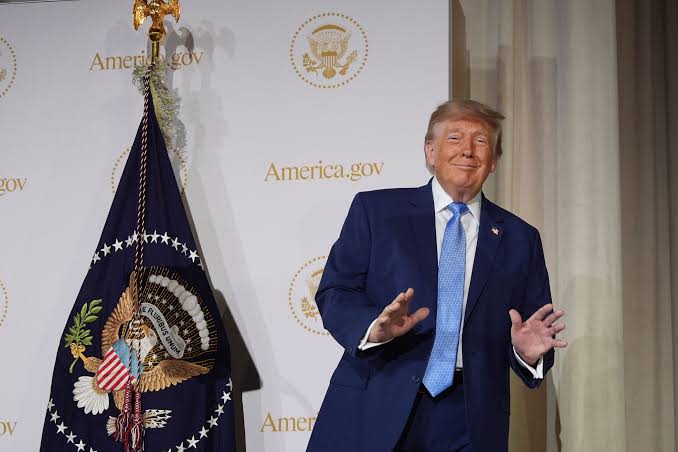
The Trump administration’s new artificial-intelligence platform, America.gov, is designed to become a digital “concierge” for the federal government, eventually helping Americans navigate everything from passport applications to Medicare enrollment.
But in its first days online, the chatbot has attracted attention for something its developers did not present as its central purpose: producing answers based on government records that sometimes contradict public statements made by President Donald Trump.
America.gov brings together information from approximately 29,000 federal government websites. Rather than requiring people to search through individual agency pages, the system uses artificial intelligence to find government information and explain it conversationally while providing citations to official sources.
For now, its capabilities are relatively limited.
The administration’s promotional materials envision a future in which users can complete complicated government tasks directly through the platform, including changing a name, applying for a passport, enrolling in Medicare or applying for federal employment.
Those functions are not currently available.
At launch, America.gov primarily operates as an information-retrieval system. Officials say this limited introduction is intentional, allowing the public to become comfortable with the technology before the government connects it to more complicated services.
Its approach to political questions has proved particularly interesting.
The chatbot repeatedly says that it does not provide political commentary. But factual questions involving politics can still produce answers based on official federal records.
When asked who won the 2020 presidential election, for example, the chatbot initially correctly identified Joe Biden as the winner.
It has also stated that grocery prices have not declined overall since January 2025, contradicting Trump’s recent claim that grocery prices had fallen since he returned to office.
Those answers are not independent political judgments by the AI.
They reflect the government information the system has been instructed to consult, including official election records, Labor Department inflation statistics and other federal databases.
That distinction illustrates both the promise and the potential vulnerability of America.gov.
The system’s credibility depends heavily on the accuracy and integrity of the government information feeding it. If agencies alter, remove or reinterpret information on federal websites, the chatbot’s answers could change accordingly.
America.gov is also deliberately cautious about personal information.
The current system attempts to stop users from entering sensitive details such as Social Security numbers and addresses. Yet personalized government services will eventually require secure identity verification and access to personal records.
The administration has demonstrated Login.gov as one possible solution, although exactly how those systems will interact remains under development.
Officials also acknowledge that expanding the chatbot into areas such as Medicare recommendations raises legal and safety questions.
Centers for Medicare and Medicaid Services Administrator Mehmet Oz has argued that a transparent government system using official information could eventually provide citizens with better guidance than general-purpose commercial chatbots.
The project also has connections to the former Department of Government Efficiency. Several people involved in developing America.gov previously worked with DOGE, including National Design Studio chief engineer Edward Coristine.
Ultimately, America.gov represents an ambitious experiment in how citizens interact with government.
Today, it is essentially an AI-powered search layer sitting on top of thousands of federal websites.
The administration wants it eventually to become something much more powerful: a single digital gateway capable of helping Americans complete complicated interactions with the federal bureaucracy.
But its early political contradictions reveal an unexpected challenge. A government chatbot instructed to rely on official records can sometimes produce answers that differ from the political messaging of the administration operating it.
That tension could become increasingly important as America.gov evolves from a relatively simple information service into a system capable of making recommendations and potentially taking actions on behalf of millions of Americans.