
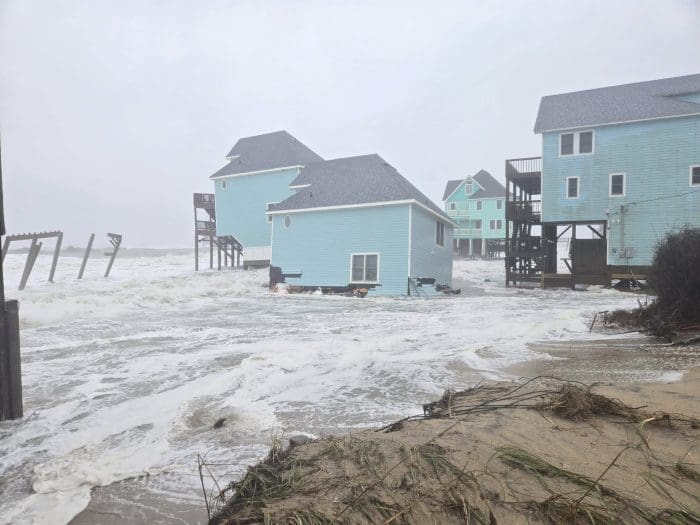
A dramatic battle is unfolding along California’s coastline as powerful waves, severe erosion and rising water threaten expensive oceanfront homes, forcing residents and government officials to confront a difficult question: how far should California go to protect private property when the structures built to save homes can accelerate the disappearance of public beaches?
The conflict has become particularly intense along Beach Road in Dana Point, where recent storms and high tides have destroyed or severely damaged several properties. Other houses remain dangerously close to collapsing as the shoreline continues to retreat.
Homeowners are now taking matters into their own hands.
Residents are spending more than $50,000 per household to construct a large temporary rock barrier designed to absorb the force of incoming waves. The California Coastal Commission granted emergency authorization for the structure, which is intended to protect 17 properties.
But homeowners want the barrier to become permanent, putting them into conflict with California’s long-standing restrictions on coastal armoring.
Seawalls and rock barriers can protect individual buildings, but coastal scientists and regulators warn that they can also accelerate beach erosion. Waves striking hard structures can remove sand and gradually narrow the public beach in front of them.
That creates a fundamental conflict between two interests: protecting privately owned homes and preserving beaches that California law treats as a public resource.
The immediate crisis has been intensified by unusually powerful ocean conditions.
A near-record El Niño has contributed to storms and high tides battering the California coast. Experts warn that the state could experience exceptionally high sea levels this winter, meaning communities already suffering erosion could face additional damage.
Dana Point is not alone.
Recent coastal erosion has caused emergencies elsewhere in Southern California. In Malibu, more than 30 oceanfront properties were evacuated after erosion damaged the only access road to a neighborhood. Other communities have experienced collapsing shorelines, sinkholes and rapidly disappearing beaches.
For Beach Road homeowners, however, the debate is intensely personal.
Some residents have already watched patios, seawalls, bedrooms and living areas collapse into the Pacific. Others have spent hundreds of thousands of dollars reinforcing properties and installing sandbags.
They argue that government agencies failed for decades to adequately replenish disappearing beaches and are now preventing homeowners from taking the measures necessary to protect their investments.
Orange County Supervisor Katrina Foley has similarly argued that insufficient action over many years contributed to the current crisis. Local governments are now pursuing beach nourishment projects that would add sand to heavily eroded areas.
The California Coastal Commission sees the problem differently.
Officials argue that permanent seawalls may protect individual properties temporarily while worsening the long-term disappearance of the beach itself. Alternatives include adding sand, constructing cobblestone berms, elevating homes and developing broader community adaptation strategies.
Another possibility is considerably more controversial: managed retreat.
Under that approach, development would gradually move away from sections of coastline that become increasingly difficult or expensive to defend.
For homeowners who have invested millions of dollars in beachfront property, abandoning communities is understandably an unacceptable solution. Some insist their homes can survive if authorities permit stronger coastal protections.
Yet scientists and planners increasingly argue that California cannot defend every vulnerable property indefinitely.
The dispute is likely to become more common.
California is requiring coastal communities to prepare adaptation strategies for sea-level rise by 2034, forcing local governments to consider which neighborhoods can realistically be protected and which may eventually require more fundamental changes.
Beach Road therefore represents something much larger than a dispute among wealthy homeowners, regulators and local officials.
It is an early example of a challenge that coastal communities around the world will increasingly confront: when the ocean advances, governments must decide what can be defended, who pays for that protection and whether saving private property today could mean losing public coastline tomorrow.
For Dana Point residents, however, that long-term debate is colliding with an immediate reality.
Another powerful surge could arrive within weeks—and their homes are already standing at the edge.